The short answer
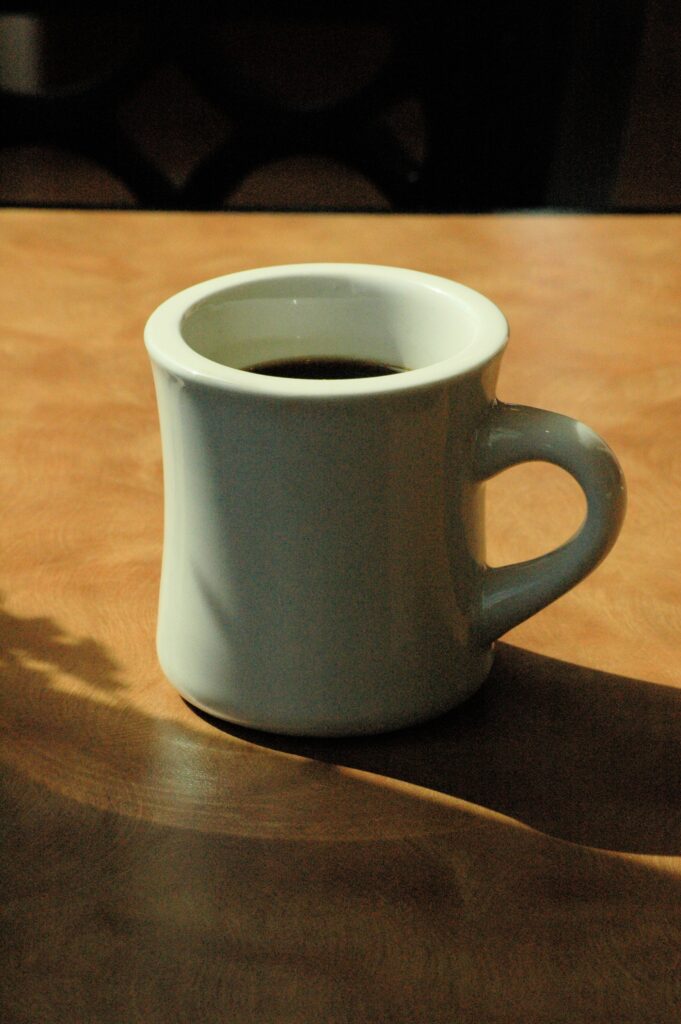
Mug shapes reflect choices about holding, drinking, manufacturing, appearance and care—not one universally best design. Handle clearance determines where your fingers fit; the rim provides the drinking edge; capacity and weight affect the load you lift; and the base contributes to stability. Documented designs also show that practical objects can carry decorative or commemorative purposes. Start by comparing mugs you already own, using cool water rather than a hot drink. (eastfork.com)
1. Mug design has more than one job
A mug can be a drinking vessel, a decorative object and a reminder of a person or occasion. Its design does not necessarily prioritize all three equally.
Museum records make that distinction useful. The National Gallery of Victoria identifies Eric Ravilious’s Alphabet pattern mug as earthenware, designed in 1937 and manufactured in the 1940s. The Fitzwilliam Museum documents another Ravilious mug made for Edward VIII’s planned 1937 coronation, which never took place because the king abdicated. Its design was subsequently adapted for other coronations. These are documented histories—not evidence that either mug offers superior everyday comfort. (ngv.vic.gov.au)
A different approach appears in Kaj Franck’s Teema collection. Iittala describes its pieces as derived from circles, squares and rectangles. Its documented 0.3-liter recirculated-ceramics mug uses a restrained form rather than elaborate decoration. (iittala.com)
The practical lesson is not that plain mugs work better. It is to separate questions:
- What does this object mean to me?
- How well does it suit the way I drink and wash dishes?
A sentimental mug need not become your daily mug to deserve a place in your home.
2. Handle clearance matters more than the outline alone
Two handles can look similar in a photograph but fit your hand differently. Examine the opening between the handle and the mug body, not just the outer silhouette.
East Fork’s account of developing its mug explains that translating handmade handles into press molds involved changes to their width, proportions and weight in the hand. In a separate first-person design account, the maker emphasizes how the handle distributes weight across the hand. That is useful evidence of a design problem, but it does not establish a handle shape that will suit everyone. (eastfork.com)
For your own comparison, ask:
- Can you use your usual grip without squeezing fingers into the opening?
- Where does your thumb naturally rest?
- Do your knuckles touch the mug body?
- Can you lift and lower it without adjusting your grip?
- Does the handle feel comfortable when the mug contains your normal amount of liquid?
Treat these as personal observations, not a scoring system. A spacious handle is not automatically the right one for you, and a small handle is not automatically a flaw.
Common mistake: choosing a mug solely by its empty feel. Compare it again with cool water at your usual fill level. Keep the mug over a table or sink, and stop if the grip feels insecure.

3. The rim is both a shape and a surface
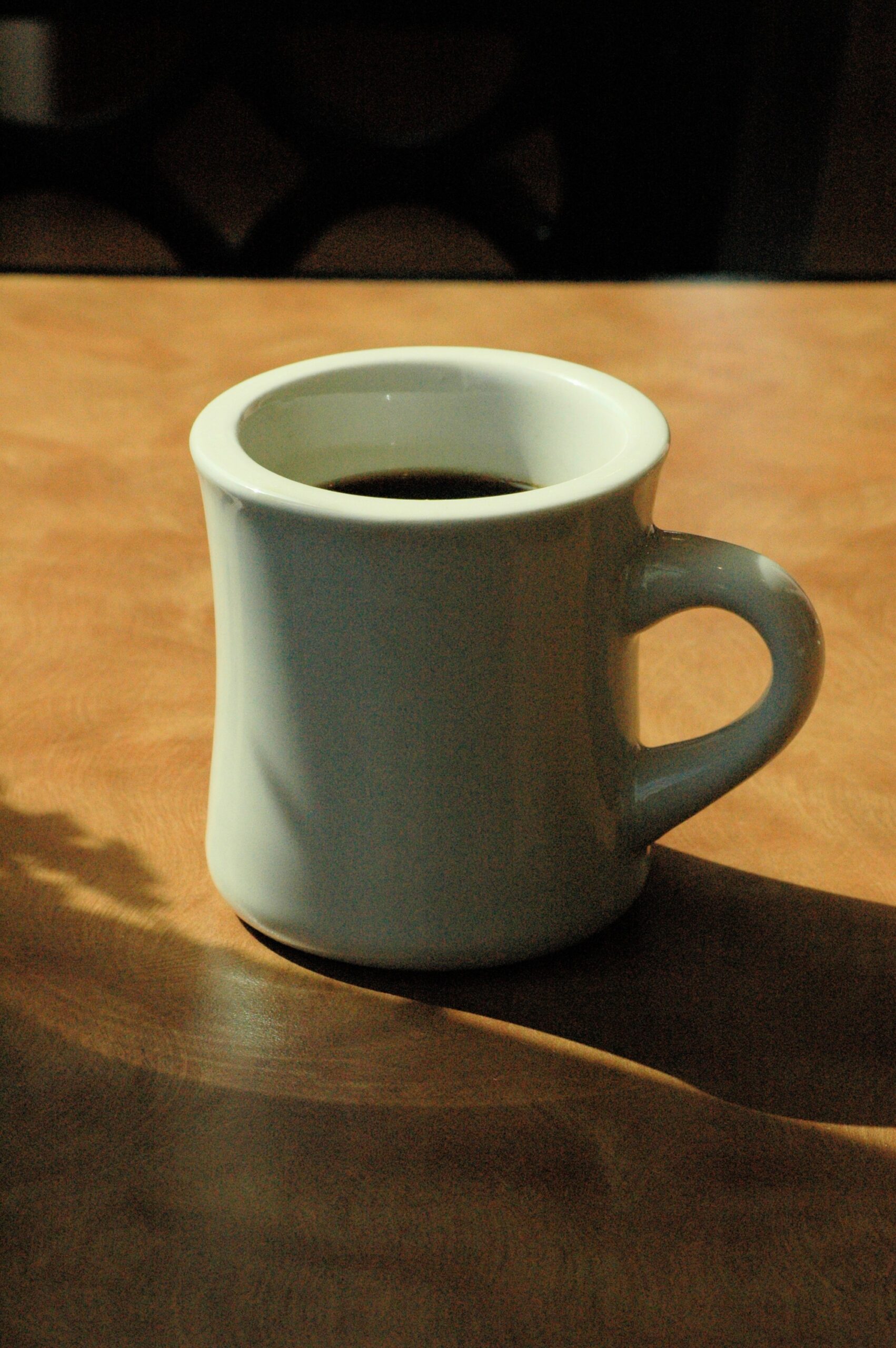
Look at a mug sideways. Is the drinking edge rounded, relatively thin, thick, flared outward or turned slightly inward? Then look from above: is the opening broad or narrow?
These are useful features to notice, but avoid assigning them universal rankings. Instead, use cool water to observe how the rim meets your lips, how far you tilt the mug and whether you can take the sip you want without an awkward adjustment.
Surface finish is another design choice. Hasami Porcelain describes the edges of its Original collection as unglazed so users can feel the underlying material. East Fork’s manufacturing account likewise documents deliberately removing glaze from its mug’s rim. An unglazed edge is therefore not necessarily an unfinished or defective edge. (hasami-porcelain.com)
That does not mean every rough or damaged rim is intentional. For an unfamiliar mug, check its maker’s description and inspect the edge before use.
Try these checks:
- Look under good light for chips, cracks or irregular patches.
- Notice whether the edge feels pleasant during a cool-water sip.
- Check whether you prefer the texture of a glazed or intentionally unglazed rim.
- If you use a brewing basket, confirm its actual fit rather than judging from the mug’s appearance.
Common mistake: assuming “thin,” “thick” or “handmade” guarantees a particular drinking experience. Your observation is more useful than the label.
4. Capacity and weight need to be considered together
A capacity figure is useful only when you know what it describes. Is it the amount the mug holds to the brim, or the amount intended for comfortable drinking?
East Fork makes the distinction explicit for The Mug: its listing says it holds 10 ounces comfortably and 12 ounces to the brim. The same listing gives a weight of 1 pound and identifies the material as stoneware. These are manufacturer specifications, not measurements made for this article. (eastfork.com)
Hasami Porcelain uses a different labeling approach. Its Original mug listings explicitly identify “Actual Drinking Capacity,” including versions marked 8, 12 and 14 ounces. The wording matters when comparing them with another maker’s nominal capacity. (hasami-porcelain.com)
Worked example: matching a mug to a drink
Suppose your usual coffee, including milk, totals 10 fluid ounces. Against East Fork’s published figures:
| Check | Result |
|---|---|
| Usual drink | 10 fluid ounces |
| Published comfortable capacity | 10 ounces |
| Published brim capacity | 12 ounces |
| Difference between drink volume and brim capacity | 2 fluid ounces |
On capacity alone, that drink matches the maker’s comfortable-fill figure. The remaining 2 fluid ounces describe volume below the brim—not a measured vertical gap and not a guarantee against spills.
You would still need to assess the loaded grip, rim and cupboard fit. Capacity cannot answer those questions.
For mugs already at home, use a measuring jug to find your preferred working volume. Avoid filling to the brim simply because the mug can hold more. If lifting is the issue, first try a smaller serving in a mug you own before deciding you need a replacement.
5. The base affects stability, manufacturing and drainage
Turn an empty mug upside down. Some have a broad, comparatively flat bottom; others stand on a raised ring, commonly called a foot ring.
Ceramic specialist Tony Hansen’s Digitalfire reference explains that foot rings raise a vessel off the table and help with glazing the underside. It also documents a mug foot ring with channels intended to drain dishwasher water. The base is therefore part of the manufacturing and care design, not merely decoration. (digitalfire.com)
For stability, basic physics provides a useful principle: an object becomes unstable when its center of gravity moves beyond its base of support. A broader support base and a lower center of gravity generally improve resistance to tipping. Applied to mugs, this explains why the part actually supporting the vessel matters—not simply its widest visible diameter. It does not establish which of two real mugs will withstand a particular bump. (openstax.org)
Make a low-risk check:
- Put the empty mug on a clean, flat surface.
- Apply light alternating pressure near opposite sides of the rim.
- Notice whether it rocks.
- Repeat on another flat surface to rule out the first surface.
- Check the underside for attached debris or visible damage.
Do not conduct a tipping test with hot liquid.
Common mistake: treating a heavy mug as automatically stable. Weight alone does not describe the relationship between its support base and center of gravity. (openstax.org)
6. Cleaning instructions belong to the specific mug
Material names are not complete care instructions.
Iittala lists its particular 0.3-liter recirculated-ceramics Teema mug as bone china and dishwasher- and microwave-safe. By contrast, the V&A Shop lists Wedgwood’s King Charles Coronation mug—also fine bone china, but with hand-applied gold lining—as handwash only. The comparison shows why you should check the specific item rather than infer care from “bone china.” (iittala.com)
Shape deserves a practical check too. Before making a mug part of your routine, ask:
- Can your usual sponge or brush reach the interior bottom?
- Can you clean around the handle attachments?
- Does it fit your dishwasher rack without being forced against neighboring dishes?
- Does water collect in the underside recess after washing?
- Is the care marking legible, or can you locate the maker’s instructions?
Digitalfire’s drainage-channel example confirms that water collection beneath a mug is something designers may address deliberately. If your mug retains water there, allow it to drain and dry rather than putting it straight into the cupboard. (digitalfire.com)
For an unidentified inherited or secondhand mug, do not assume dishwasher or microwave suitability from appearance. Ask the maker if identifiable; otherwise leave those permissions unconfirmed.
A mug requiring handwashing may still be worth keeping. The useful question is whether that extra step fits its intended role in your home.
7. Compare the mugs you own before buying another
You do not need a matching set or specialist equipment to learn what works for you. Choose two or three intact mugs, a measuring jug, cool water and a flat surface.
This is an observation exercise—not a laboratory test or a claim that the mugs have been tested for this article.
First, choose the task. Are you looking for a mug for a short morning coffee, a longer cup of tea or a drink carried between rooms? Compare mugs for one task at a time.
Then record a few useful observations:
| Feature | What to note |
|---|---|
| Handle | Your grip, finger clearance and any uncomfortable contact |
| Rim | Texture, lip contact and how naturally you sip |
| Working capacity | The measured amount you actually want to drink |
| Loaded feel | Whether lifting and lowering feel comfortable |
| Base | Whether it sits evenly on a flat surface |
| Cleaning | Verified care instructions and access with your usual tools |
| Storage | Fit in the space available, including the handle |
Finally, give each mug a role rather than a rank. One might suit daily coffee; another might be better for a smaller serving. A commemorative mug might be kept for its story without being used for drinks.
Avoid buying a replacement until you can name the problem it should solve: “I need more handle clearance” is more actionable than “I need a better mug.”
The goal is not to identify the objectively perfect mug. It is to understand why you reach for one—and whether another object already in your cupboard can meet the need.